
Public Officials’ Pay, Minimum Wages, and Corruption: What the Data Shows
Published:
Amid the salary increase for DPR, I collected data from several countries on four things:
- The monthly salary and allowance of public officials.
- The minimum wage.
- The ratio between the two.
- The Corruption Perceptions Index (CPI), which measures how clean or corrupt a country is perceived to be (0 = very corrupt, 100 = very clean).
And let me tell you folks: it is bad for us Indonesians. Like, really bad. Here are three insights:
Pay gaps between officials and workers
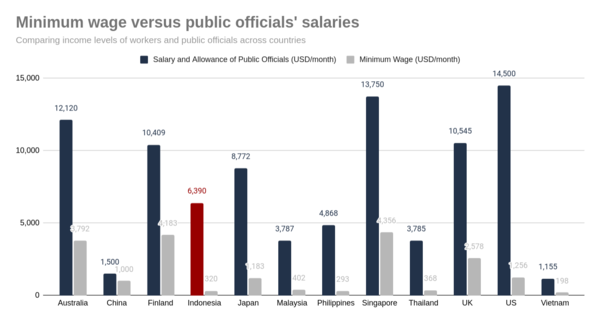
A public official in Indonesia earns about $6,390 per month, while the minimum wage is $320. Compared that to, say, US. A US official earns $14,500 per month, about 12 times the minimum wage of $1,256. But absolute pay gaps do not tell the full story. Someone in Indonesia earning $1,000 per month is likely to live far better than someone earning $2,000 in the US. Therefore, let us look at:
Relative pay gaps between officials and workers
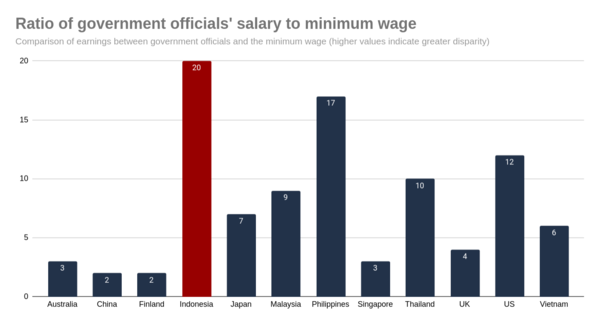
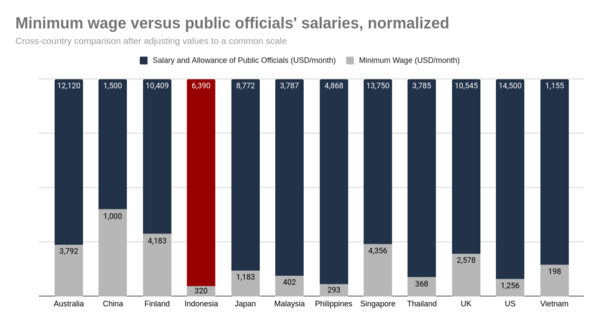
In Indonesia, public officials earn about 20 times the minimum wage. In the Philippines, it is 17 times, and in the US, 12 times. On the other end, Finland and China have only a 2x gap, while Singapore and Australia are around 3x.
This means that in some countries, public officials’ income is much closer to that of regular workers, while in others, the gap is extremely wide. In concrete terms, a government official in Indonesia can live about 20 times better than someone earning the minimum wage!
Pay gaps and corruption
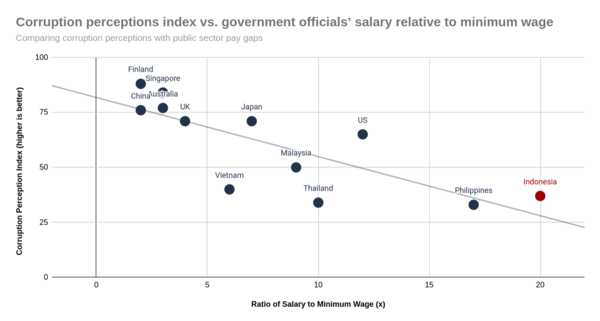
During his presidential campaign debate, President Prabowo suggested increasing government officials’ salaries to reduce corruption. However, when I compared the ratio of salaries to minimum wages against the CPI, a pattern emerged. Countries with smaller gaps (2–4x) tend to have higher CPI scores (less corruption). Finland, Singapore, and Australia fall into this group. Meanwhile, countries with larger gaps (10–20x) often have lower CPI scores (more corruption), such as Indonesia, the Philippines, and Thailand.
This challenges the idea that simply increasing salaries will reduce corruption.
Why this matters
These numbers show a big problem: officials are earning much more than regular workers. At a time when many Indonesians are struggling to get by, we need to rethink whether raising officials’ salaries makes sense. If we want less corruption and better government, higher pay alone won’t fix it. Now is the time to ask more from our leaders, not give them more.