
Proving the Pareto Principle with Data
Published:
I am a big fan of the Pareto Principle, which states that 80% of results often come from just 20% of efforts. But how can we prove this principle with data?
To explore this, I analyzed a subset of Wikipedia text (God I love this). Here’s what I did:
- Created a list of all unique words appearing in the original document.
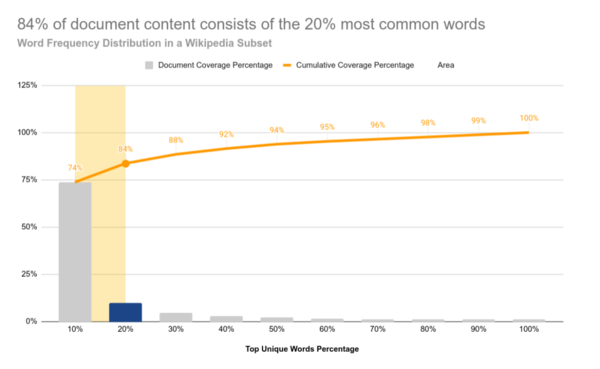
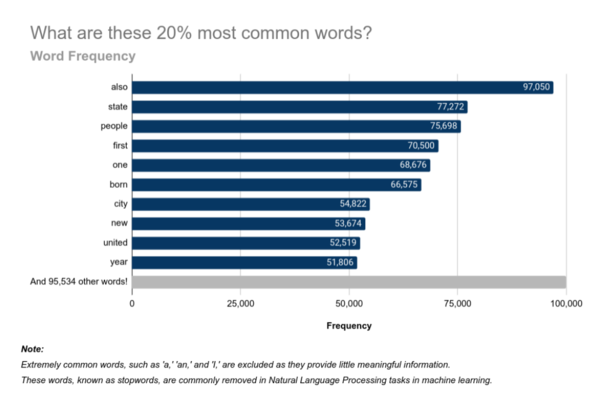
- Identified the top 20% most common words.
- Checked how much of the original document these words covered.
The result? These 20% most common words made up 84% of the document! Pareto Principle FTW!
What does this mean in practice? Assuming this Wikipedia subset is representative of how we use English, understanding the 20% most common words could get you 80% of the way to understanding the language. Isn’t this crazy?
The same idea applies to other areas of life. For example:
- At work: With so many tasks competing for your attention (I feel you), focusing on the 20% that truly matter can drive 80% of your impact.
- In relationships: Investing in the 20% of connections that are most meaningful can bring 80% of your personal fulfillment.
- In personal growth: Whether it’s learning a new skill, improving your health, or managing your time, focusing on the 20% of activities with the highest payoff can yield 80% of the results.
Prioritize wisely.