
Prisoner’s Dilemma: Why Being “Good” Wins in Game Theory
Published:
In the mathematical field of game theory, there’s a game known as the Prisoner’s Dilemma. The game unfolds as follows:
Two participants face each other. Each can choose to cooperate or defect, with outcomes:
- Both cooperate: 3 points each
- One defects, the other cooperates: Defector gets 5 points, cooperator gets 0
- Both defect: 1 point each
The game consists of multiple rounds, with points tallied for each participant. The one with the most points wins.
At first glance, it seems you must defect and hope your opponent cooperates to win—essentially betraying them. But does success in this game truly require “evil” behavior?
I recently ran a simulation to test various strategies for this game, categorizing them into two types:
- Good Strategies (do not defect first)
- Evil Strategies (defect first)
Strategy List
| Strategy Name | Type | Description |
|---|---|---|
| Unconditional Cooperator | Good | Always cooperates |
| Tit for Tat | Good | Starts by cooperating, then mirrors the opponent |
| Generous Tit for Tat | Good | Like Tit for Tat, but forgives occasional defections |
| Tit for Two Tats | Good | Cooperates unless defected against twice in a row |
| Two Tits for Tat | Good | Defects twice after being defected against, then cooperates |
| Grim Trigger | Good | Cooperates until the opponent defects once, then defects permanently |
| Probability Cooperator | Good | Cooperates with high probability, defects occasionally |
| Unconditional Defector | Evil | Always defects |
| Suspicious Tit for Tat | Evil | Defects initially, then mimics the opponent |
| Pavlov | Evil | Switches strategies based on the last round’s outcome |
| Alternator | Evil | Alternates between cooperating and defecting |
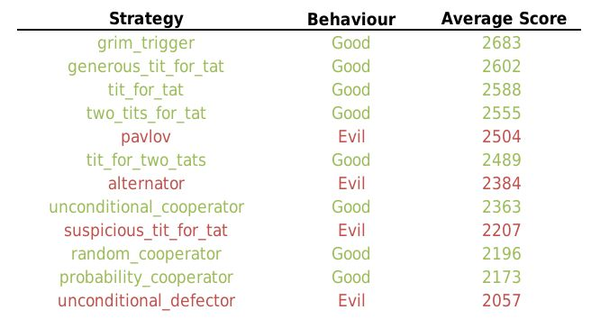
You can see the ranking table in the image below.
The simulation results reveal a clear trend: good strategies outperform evil ones.
Analyzing the winning strategies, we found that the key factors for success in this game are:
- Being nice – don’t try to take advantage of others
- Being forgiving – be willing to forgive others if they wrong you
- Not being a pushover – sometimes retaliate if wronged
- Being clear in your intentions – avoid being too unpredictable
While good strategies don’t always win in every matchup (e.g., Tit for Tat loses to Unconditional Defector), they generally score better overall. Notably, the top three strategies are all good, while the most “evil” strategy, Unconditional Defector, ranks the lowest.
This result is almost poetic. Even mathematics teaches a life lesson:
To be successful, one should be kind, forgiving, assertive, and transparent.
This lesson extends beyond the game, highlighting the value of these traits in real life.
Check out the simulation code on my GitHub.
- Inspired by Veritasium’s video: What Game Theory Reveals About Conflict and War
- Stanford’s strategy table