
Analysis: Jakarta’s Traffic Problem Is Actually a Housing Problem
Published:
Everyone who has spent time in Jakarta knows the traffic. The jams start before sunrise and do not really end until late at night. Billions of Rupiah in productivity are lost every year. Commuters spend hours each day just getting to work and back. This is widely accepted as a fact of life in the city.
But here is what rarely comes up in the conversation: traffic is not the actual problem. Traffic is a symptom. The real problem is that jobs and homes are in completely the wrong places relative to each other. This is called spatial mismatch, and the commuter data from Jakarta and the surrounding Jabodetabek region makes the case very clearly.
Jobs cluster in a few districts, but people live everywhere else
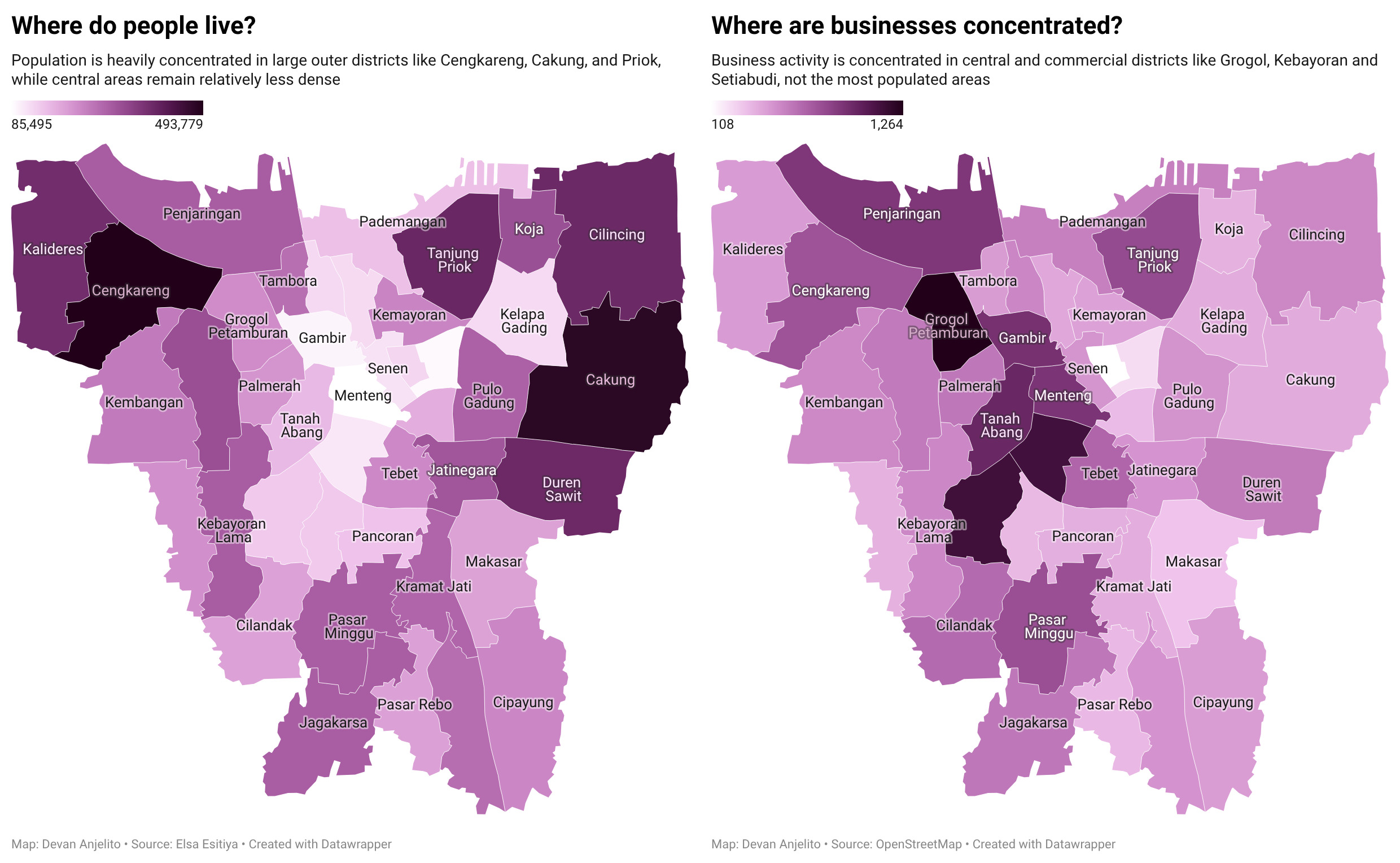
Look at Menteng and Setiabudi. Both have roughly 10 to 11 businesses per 1,000 residents. These are job-dense, high-activity districts in the heart of Jakarta. Now look at Cakung. Cakung has around 0.8 businesses per 1,000 residents but is home to nearly 478,000 people, one of the most populous districts in Jakarta.
That is a 13x difference in job density between Menteng and Cakung. A similar gap shows up between Grogol Petamburan (5.6 businesses per 1,000 residents, 1,264 businesses total) and Cilincing (1.4 per 1,000, population 388,000).
The pattern is consistent: a small number of central districts hold most of the jobs, while the residential population is spread far and wide across the city and its satellite towns.
People did not choose to live far from their jobs
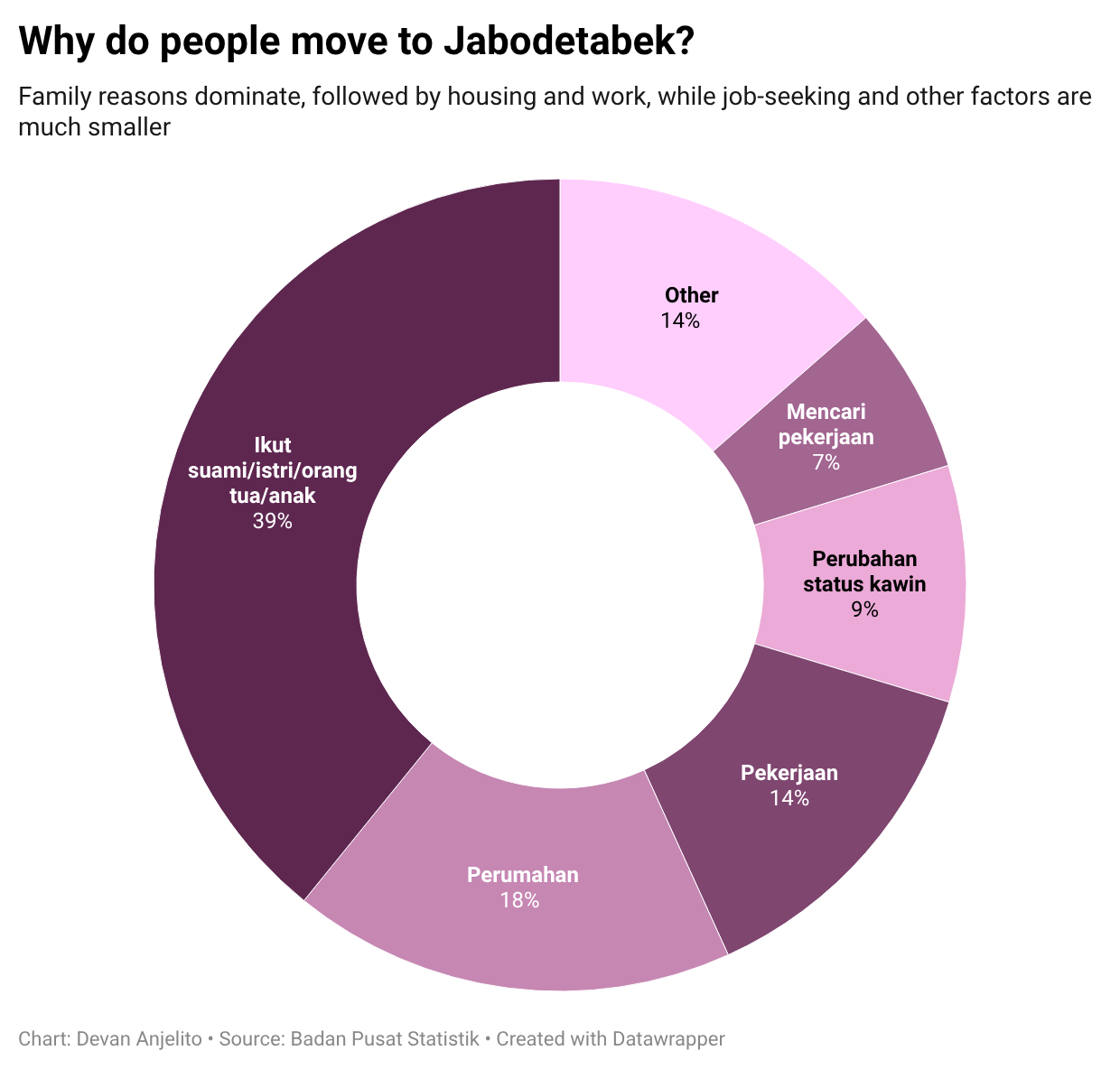
So why do so many people live so far from where the jobs are? Survey data from over 1.73 million respondents tells the story.
54% moved to follow family or a spouse. Another 18% moved for housing reasons, meaning they went where they could afford to live. Only 23% moved specifically for work. In other words, about three out of four people in Jabodetabek chose where to live based on family ties or housing costs, not proximity to their workplace. They ended up in Cakung, Kab Bogor, or Kota Bekasi because that is where their family is or where they could afford a home. The commute was an afterthought.
This is the core of the spatial mismatch problem. It is not a failure of personal planning. It reflects an urban structure where affordable housing and job centers simply do not overlap.
The result: entire cities commuting into one corridor
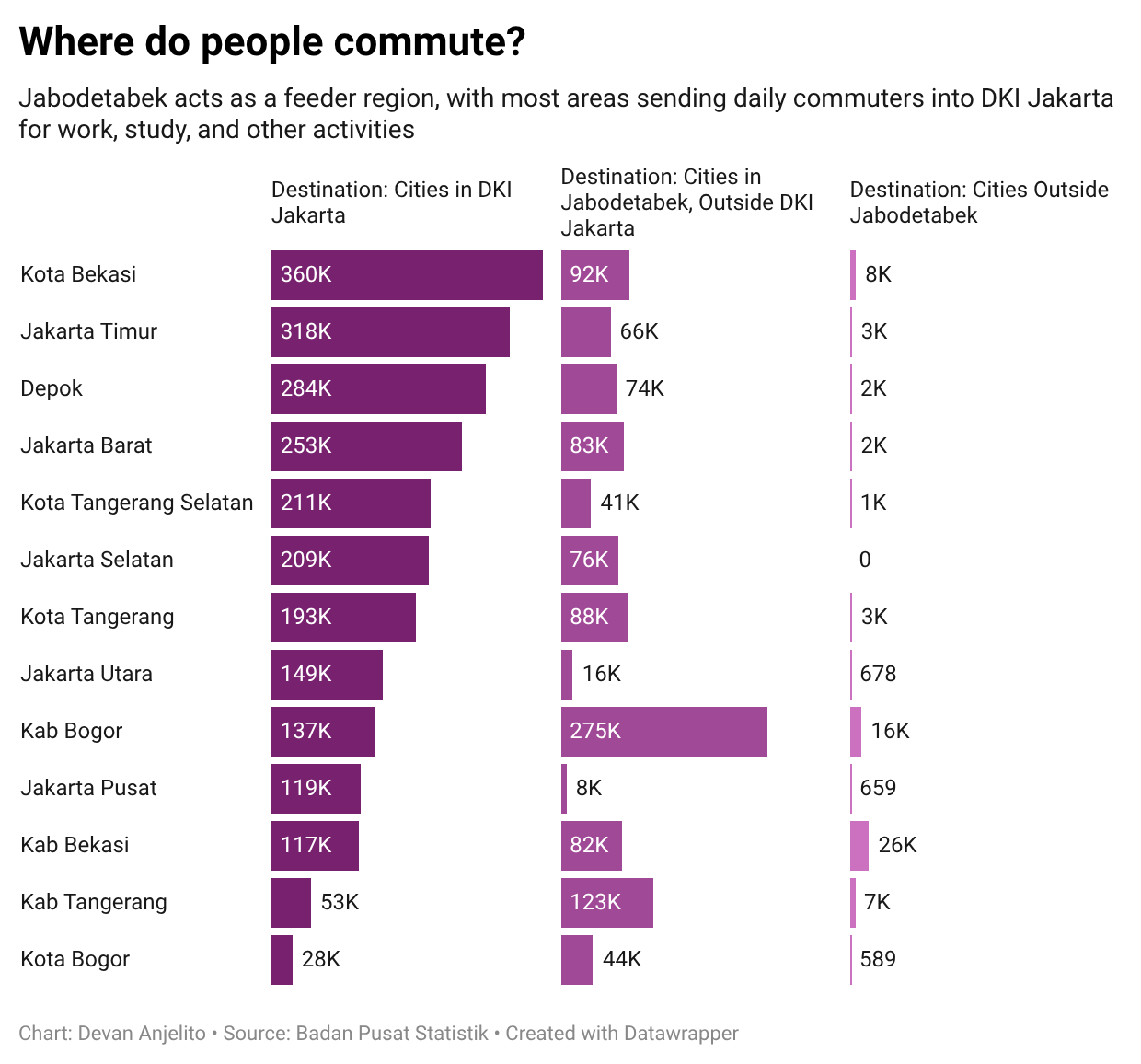
When homes and jobs are separated at this scale, the daily movement of people becomes enormous.
78% of Kota Bekasi’s 460,000 commuters travel into Jakarta every single day. Depok sends 284,000 commuters into Jakarta. Kab Bogor pushes 275,000 people into other Jabodetabek cities. These are not small numbers. These are essentially the entire working population of a mid-sized city all flowing into the same narrow corridors at the same time, every morning.
The distances involved are not short
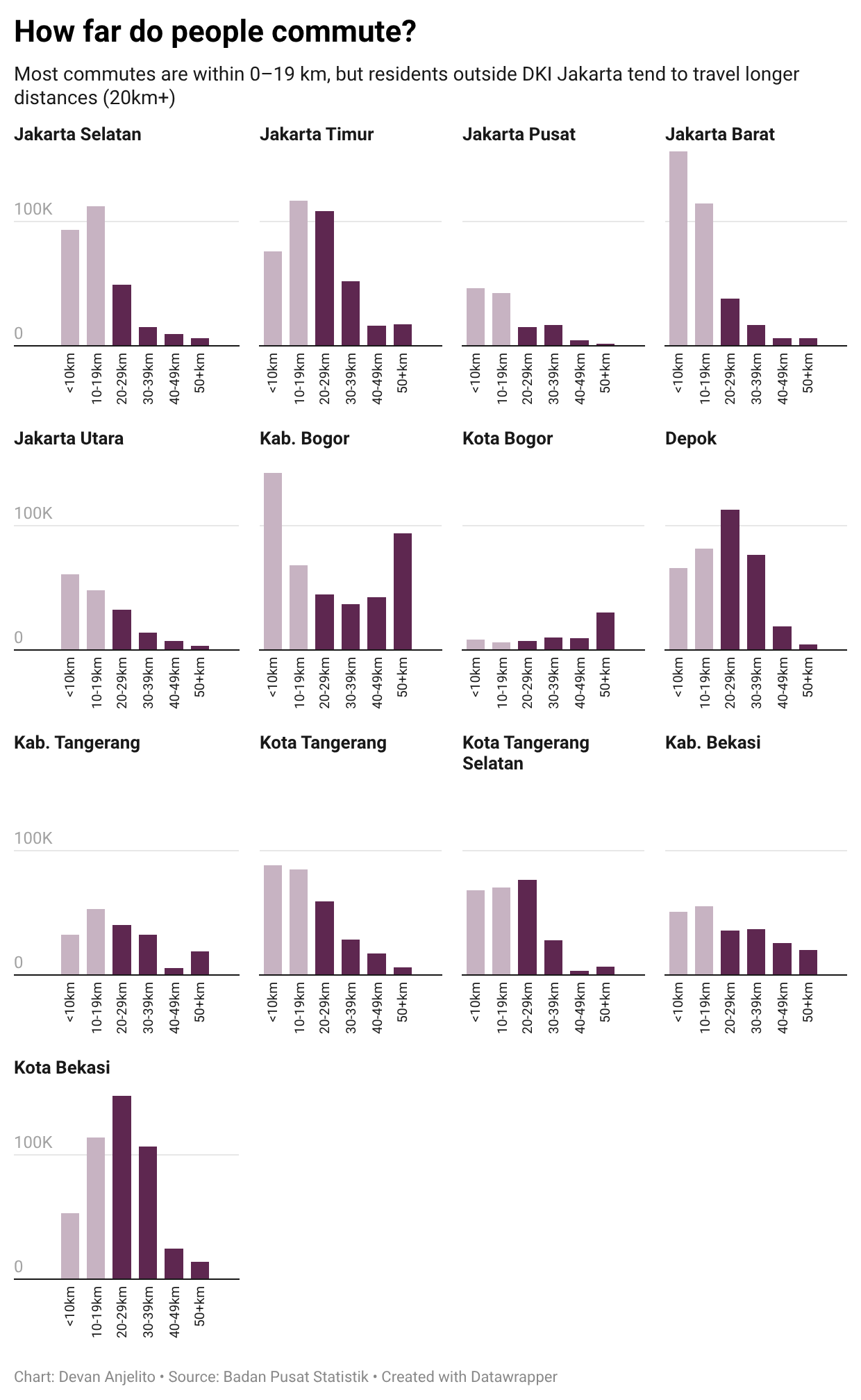
Kab Bogor has 93,941 commuters traveling 50 kilometers or more each way. This is the single largest 50+ km commuter segment in the entire Jabodetabek dataset. Kota Bekasi has over 254,000 people commuting between 20 and 39 kilometers daily. These are not trips across a neighborhood. These are cross-metro journeys, often spanning multiple cities, repeated twice a day.
Almost everyone drives
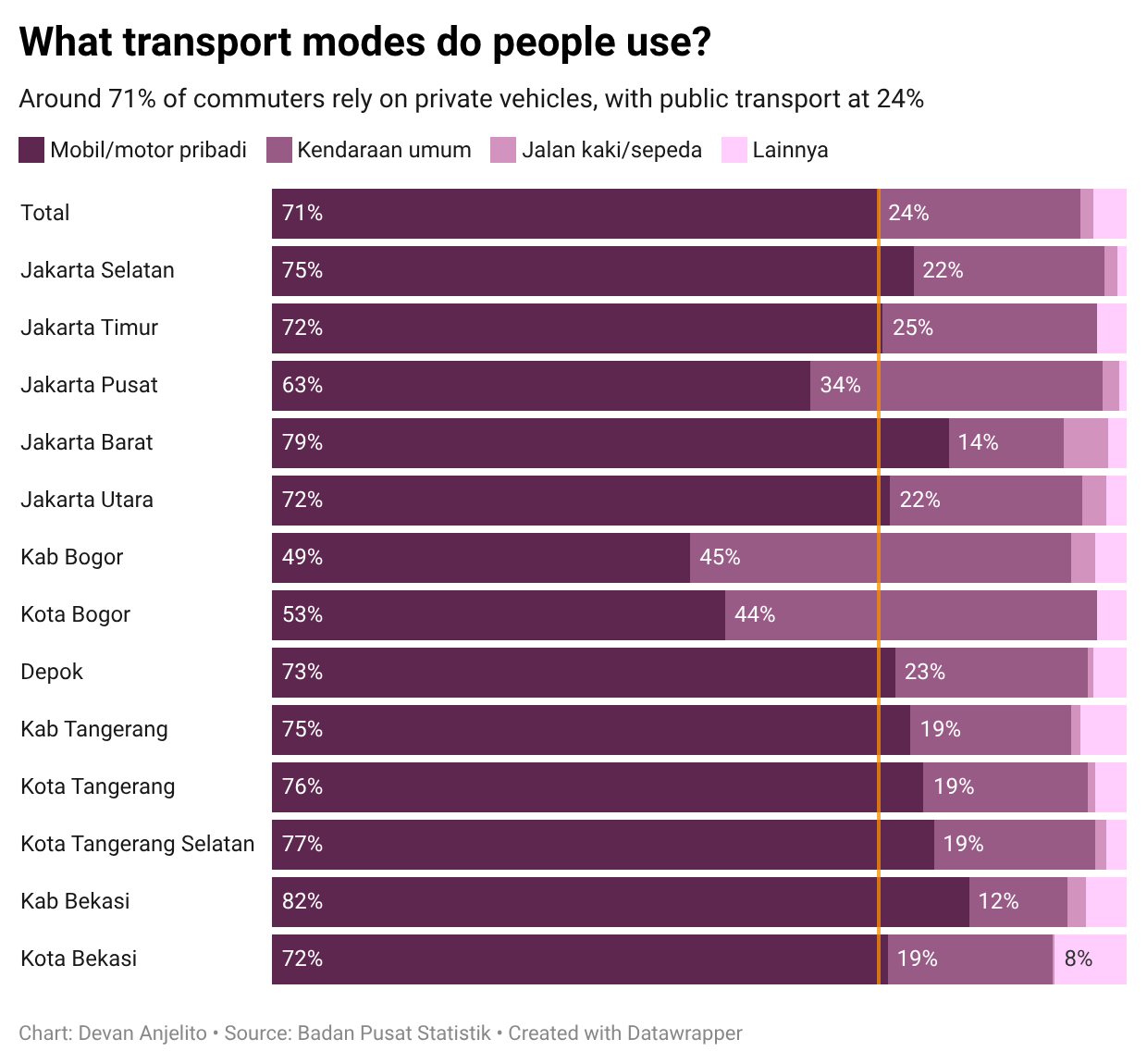
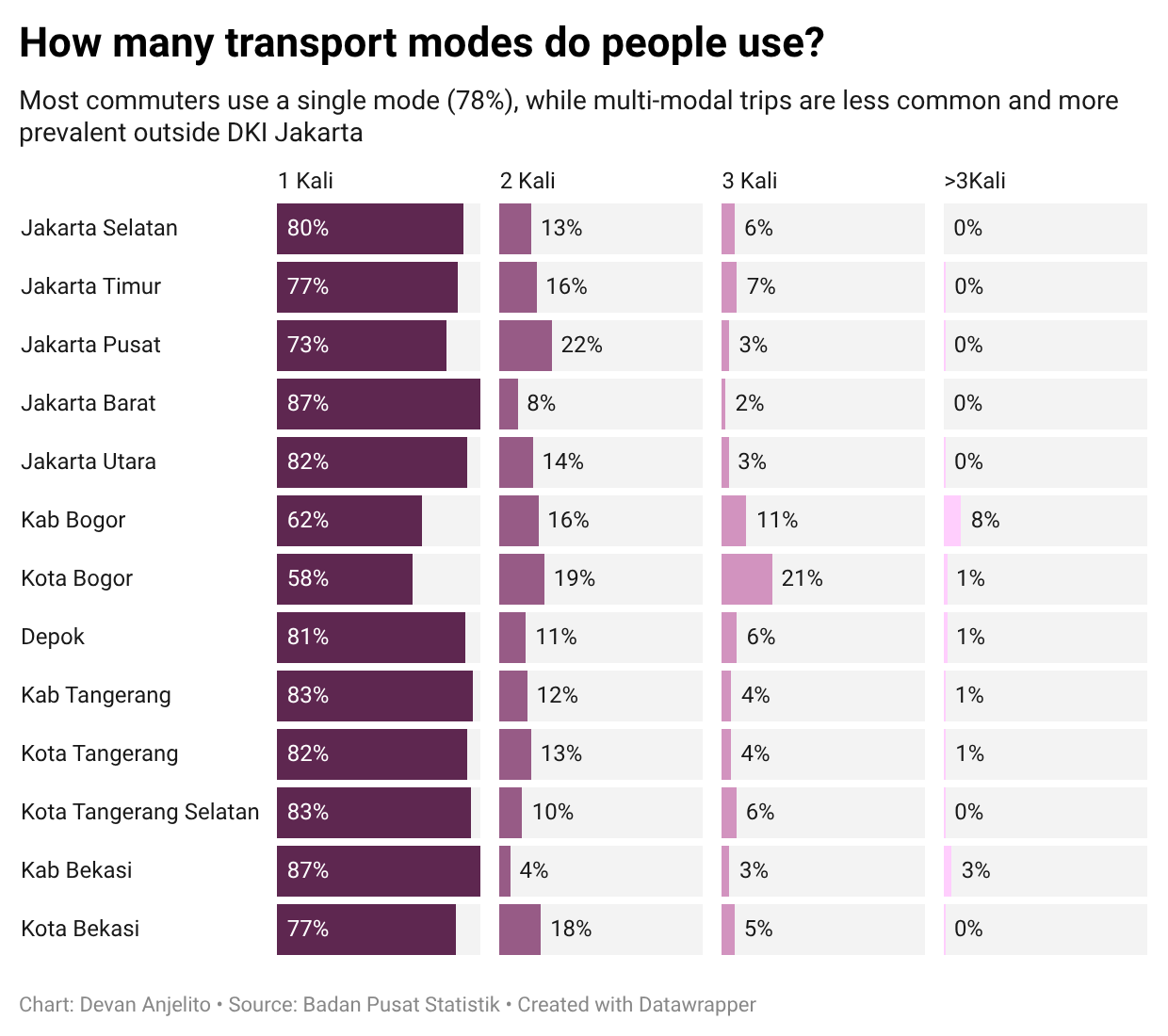
71% of commuters use private cars or motorcycles. Only 24% use public transport. And 78% use a single mode of transport, meaning most people drive door-to-door without transferring.
The reason is straightforward. When your commute is 30 or 50 kilometers and crosses multiple city boundaries, public transit options are limited and slow. A motorcycle or car gives door-to-door coverage. So people drive. Then hundreds of thousands of them converge on the same roads at the same time.
They all leave at the same hour
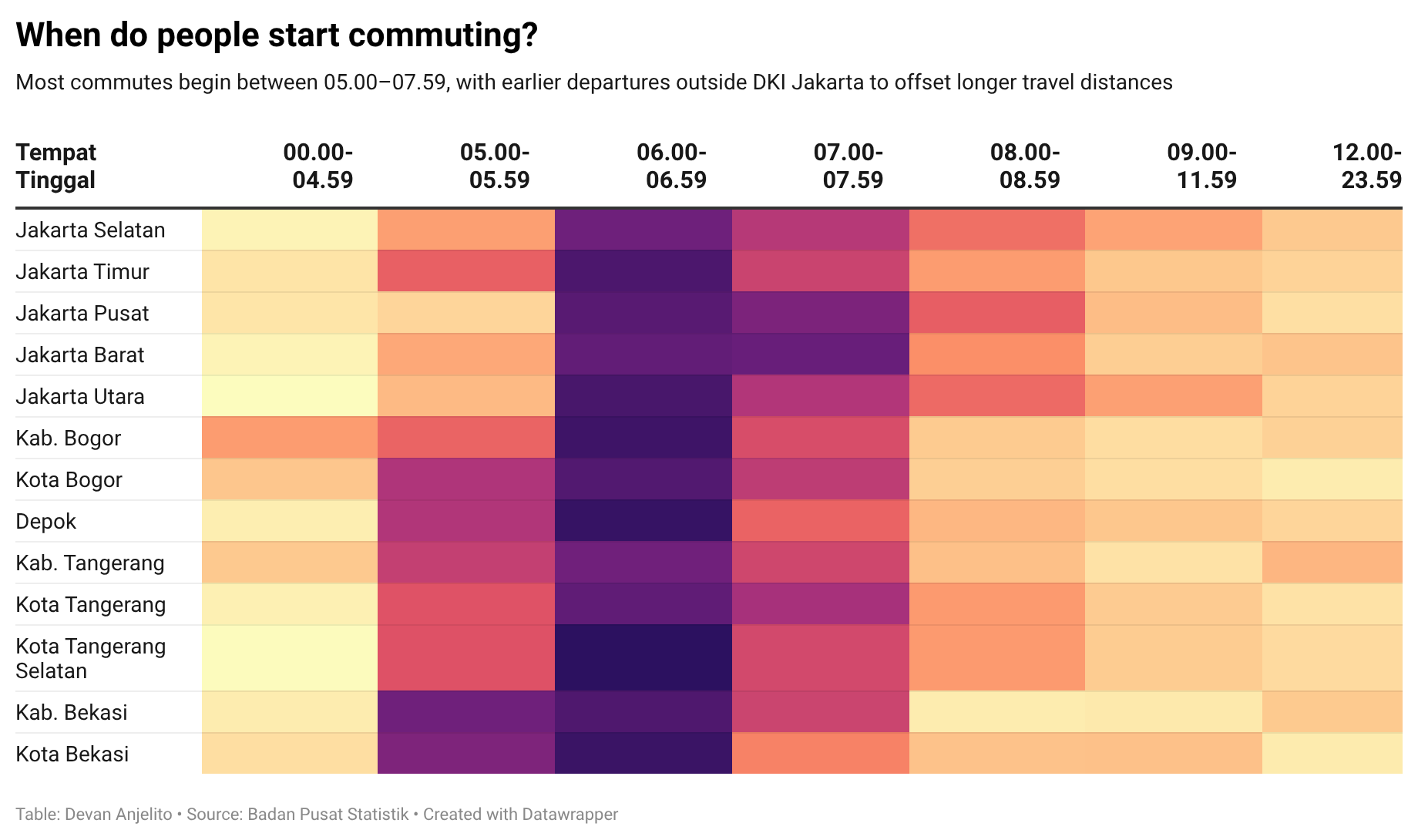
The departure time data is striking. The peak window of 06:00 to 07:59 dominates across every single city. In Kab Bogor, 28.5% of commuters are already on the road before 6 in the morning, trying to get ahead of the congestion on roads that are already filling up with other people who had the same idea.
When jobs concentrate in the same districts and hundreds of thousands of workers all need to arrive by 9am, there is no way to spread the load. The roads funnel everyone together at the same time.
These commutes eat the whole day
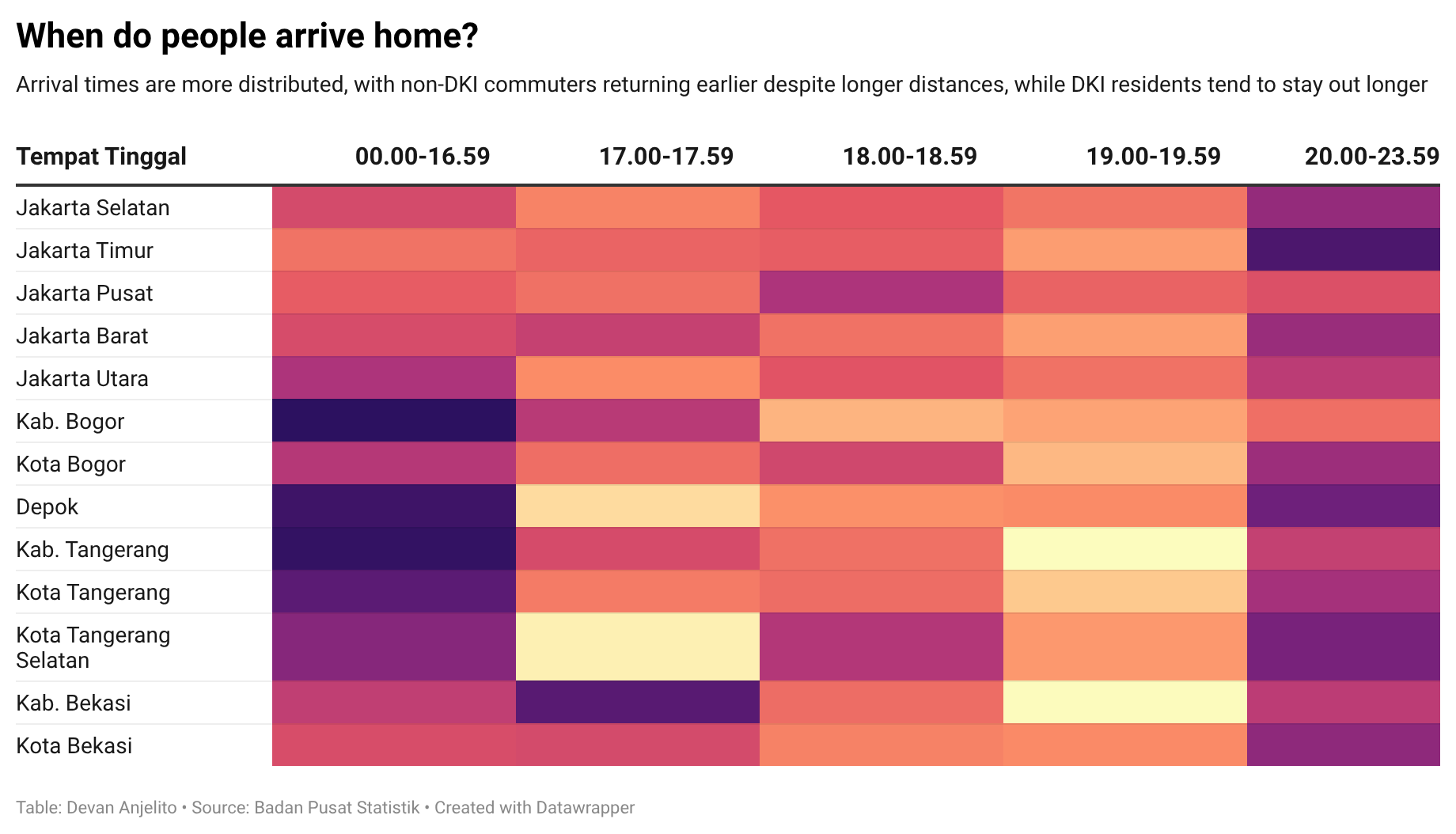
30% of commuters from Jakarta Timur arrive home after 8pm. Jakarta Selatan is at 25%. If these people left at 6am and arrive home at 8pm, that is 14 hours spent away from home, not because they worked late, but because the roads were that bad.
This is what a 20 or 30-kilometer commute looks like when roads are saturated and public transit does not adequately bridge the gap. The commute does not just eat time. It reshapes how people spend their lives.
And commuters feel it
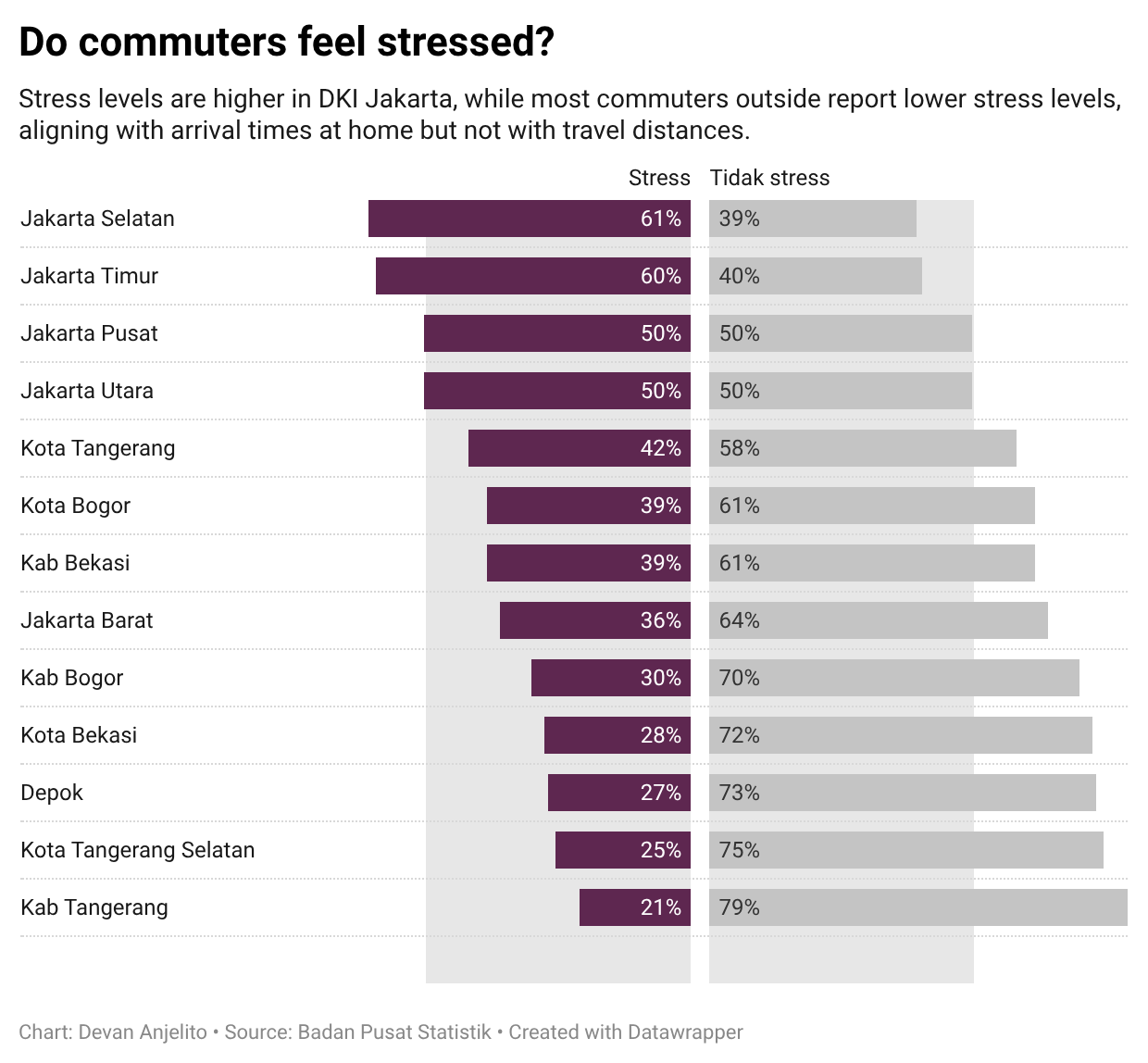
61% of commuters from Jakarta Selatan report feeling stressed. Jakarta Timur is at 60%. Overall, 38% of commuters across Jabodetabek say their commute is stressful.
The areas with lower stress tend to be those with shorter average commute distances. Kab Tangerang is at 21%. Depok and Kota Tangerang Selatan are both around 25 to 26%. The pattern is not a coincidence. Shorter distance and less cross-city flow mean less friction, and less friction means less stress.
What this means
Adding lanes does not fix a housing problem. Odd-even rules do not fix a housing problem. Even a new toll road does not fix it, because the underlying issue is that millions of people live far from where they work, not entirely by choice, but because that is where they can afford to live and where their families are.
Solutions that actually address spatial mismatch look different:
- Distribute jobs outward. Incentivize businesses to set up offices and facilities in Bekasi, Bogor, Tangerang, and Depok rather than concentrating everything in central Jakarta.
- Build affordable housing near job centers. Allow people who work in Setiabudi or Gambir to live within a reasonable distance of those districts.
- Build transit that genuinely bridges the gap. A 50-kilometer commute from Kab Bogor is manageable if a fast, reliable train covers it in 45 minutes. Right now, it is mostly done by road.
Jakarta’s traffic is one of the most visible and most-discussed urban problems in Southeast Asia. But the conversation usually stays at the symptom level: more roads, more rules, more enforcement. The data points to a different root cause, one that sits in urban planning, housing policy, and economic geography.
Until the mismatch between where people live and where the jobs are is reduced, the traffic will keep coming back.
Data limitations
The analysis above is built from three datasets: commuter flows, population counts, and business locations. But here is an important caveat: public data on commuting in Indonesia is extremely limited. The commuter survey cited here is from 2014. Population and business data are approximations from secondary sources.
To truly understand and address spatial mismatch in Jakarta, we would need: current commuter origin-destination data broken down by route and time, real-time traffic patterns, detailed income and housing affordability data by district, and employment counts by sector and location. Indonesia produces far less of this data systematically than comparable cities in other countries. More granular, recent, and regularly updated data would paint a much clearer picture and help policymakers design better solutions.
Sources
- Commuter data: Badan Pusat Statistik (Central Statistics Agency). Statistik Komuter Jabodetabek: Hasil Survei Komuter Jabodetabek 2014
- Population per district: Kaggle. Dataset Kepadatan Penduduk Jakarta
- Business locations: OpenStreetMap